Which One Doesn't Belong? The Odd One Out Game for Kids
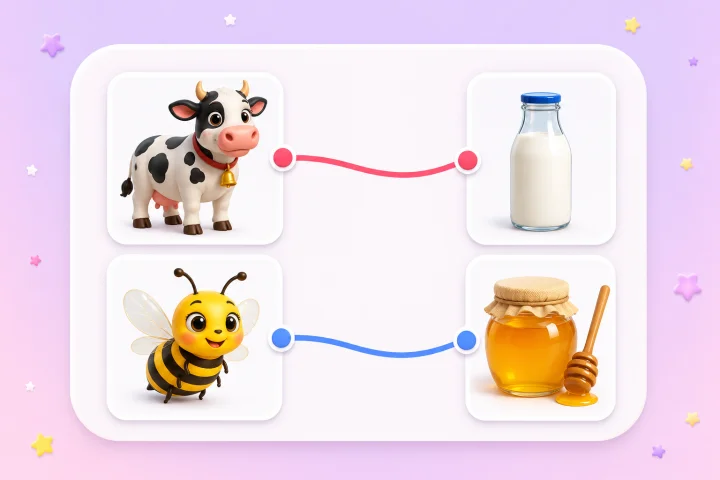
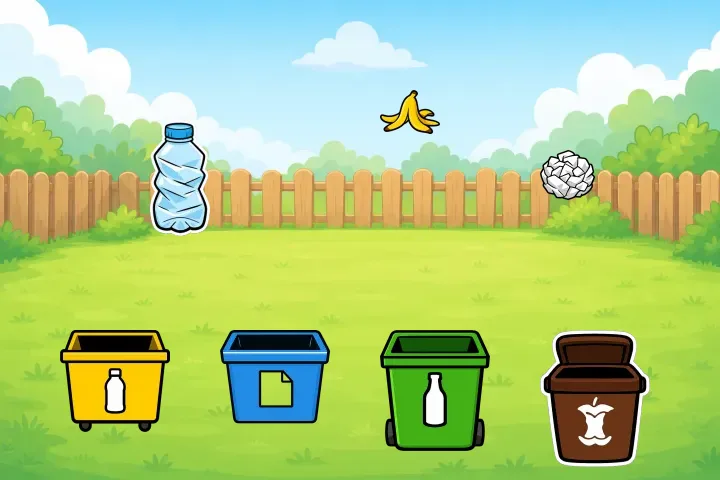
Every round shows four pictures: three of them have something in common and one sneaked in. The child looks, compares and taps the odd one. When they get it right, the game says out loud why that picture did not belong, which is where the real learning happens: pointing is not enough, you have to work out the rule the other three share.
Seventeen topics of six rounds each, ordered from the simplest to the most demanding. The first ones ask whether something belongs to a group, like which of the four is not a toy. The last ones ask you to find a rule that is not visible in the picture: three animals that fly and a hen that does not, or three things that go on your feet and a cap.
What does the odd one out game teach children?
- Categorisation: grouping things by what they have in common, the foundation of logical thinking
- Vocabulary, because every picture is named out loud in the language of the game
- Selective attention: looking at four images at once and comparing them
- Reasoning by elimination, ruling out the ones that do fit the group
- Visual abstraction: in the last topics the rule is not visible at a glance and has to be worked out
It is a preschool classic and a staple of speech therapy rooms, and it works just as well on a classroom whiteboard as on a phone at home. No sign-up and nothing to install.
Frequently asked questions
What age is this game for?
From age 4 with the first topics, which ask whether something belongs to a group. The last topics ask children to find a rule that is not obvious at first glance and work better from 6 to 8. Topics are independent, so you can start with any of them.
Is this the same as odd one out?
Yes, it is the same game. It goes by odd one out, which one does not belong, or what does not belong. The mechanic is always the same: four pictures, three that share something and one that does not.
Does the game explain the answer?
Yes. On a correct answer the reason appears on screen and is read out loud, for example "it is not a farm animal" or "it does not fly". That explanation is what turns a correct tap into actual learning.
Can I use it in class?
Yes. It runs on interactive whiteboards, tablets and computers, needs no sign-up and can be projected so the whole group joins in. Topics are independent, so you can pick the one that matches your lesson.
What happens when a child gets it wrong?
Nothing is lost and nothing restarts. The picture shakes and the round stays open for another try. Only the first attempt counts towards the score, but the game never locks the child out.
Which One Doesn't Belong? belongs to two collections: logic games and language games.