Word search for kids
Three sizes, with a picture and a voice for every word.
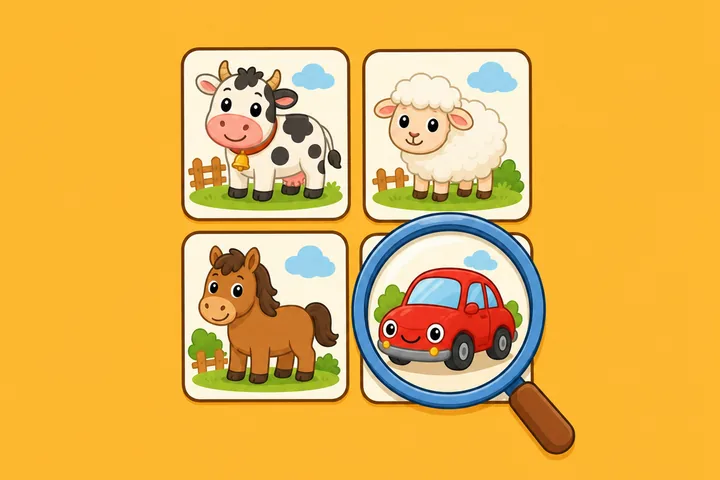
A classic word search asks you to read first. This one does not: next to the grid sits the word list, and each word carries its picture, which says its name when tapped. A child who cannot read yet sees the cow, hears "cow" and hunts for the three letters; a child who reads, reads. You mark a word by dragging across the letters from the first to the last, and it stays painted in colour.
The small grid is 6×6 with three words in large letters, the first one a four or five year old can finish. The medium is 8×8 with five words and the big one is 10×10 with six, where diagonals appear as well. No size hides words written backwards.
Kindergarten word search, or easy word search?
People look for both, and the puzzle is the same one everybody knows: a grid of letters with words hidden inside. What changes here is the age it is built for, which shows in the size of the grid, in the pictures and in being able to hear every word.
What your child practises while playing
- Spotting the letters of a word in order, the step that comes before reading it in one go.
- Matching a picture with its written name, without having to decode it alone.
- Scanning in a straight line: to the right, downwards and diagonally.
- Staying with a search that has no timer and no penalty.
There is no clock, no score, and a wrong guess costs nothing: the mark fades and you try again. A hint lights up the first letter of a word still missing, and a new grid is one tap away.
Frequently asked questions
What age is it for?
The small 6×6 grid with three words works for four and five year olds, with the picture as their guide. The medium and big grids suit children who already read, closer to six or seven.
Does my child need to read first?
No. Every word in the list has its picture and says its name when tapped, so it can be found by matching letter by letter against what the chip shows.
Are words written backwards?
Never. They run left to right and top to bottom, and in the big grid diagonally downwards too. When marking, though, you can drag from either end.
Does it work on an interactive whiteboard?
Yes. Words are marked by dragging, the same with a finger, a mouse or a pointer, and the letters are large enough to read from the back of the room.
Is every game different?
Yes. The words are drawn from the site’s object catalogue and the grid is built on the spot, so two games in a row will not repeat.
Word Search is one of the 7 language games on Little Kids Games.